The Allied Arsenal
Every book tells you what these weapons could do.
Almost none of them tell you what it took to build one — what it cost, how many hours it consumed, which factory made it, and why a government at war chose it over the alternative.
Historical reference books built from wartime production records, ordnance department reports and period technical manuals.
Get the Free Field ReferenceNo cost. No subscription. Yours to keep permanently.
Already know what you're looking for? See The Arsenal Reference →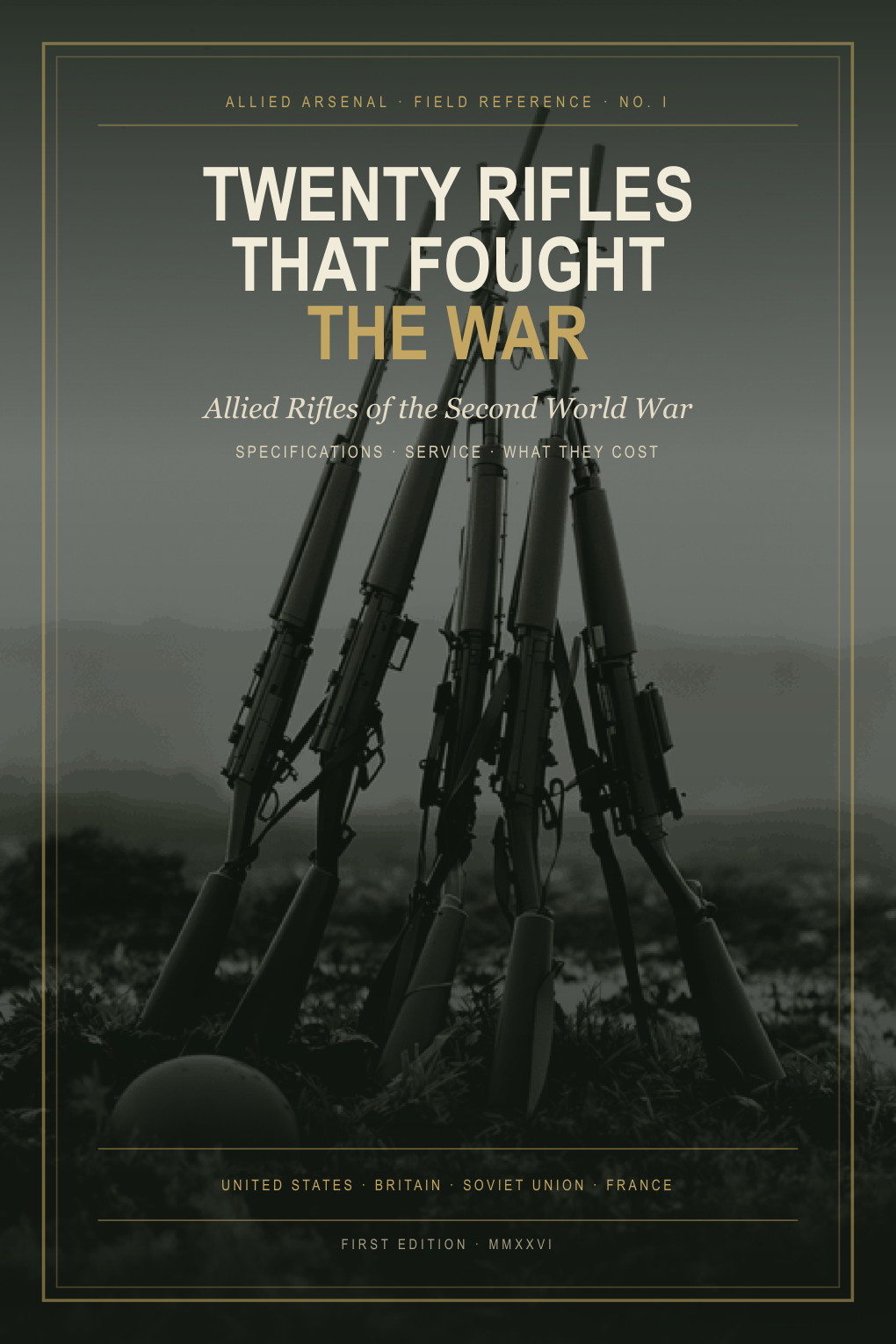
The gap
Why these references exist
There is no shortage of books on the weapons of the Second World War. Most of them tell you the same things. Caliber. Muzzle velocity. Effective range. Weight, loaded and unloaded. If you have been reading this subject for thirty years, that information is already on your shelf — probably four or five times over.
What almost none of them tell you is what it took to put those weapons in the field.
What a Garand cost the government in 1941, and what it cost in 1945. How many machine-hours went into a Thompson before Savage redesigned it, and how many after. Why the Red Army stopped building the ZiS-2, and what changed on the battlefield that made them start again.
Those answers exist. They are in ordnance department reports, procurement files and production summaries. They are simply not in the books.
Weapons were not chosen because they were the best. They were chosen because a government under pressure — with limited steel, limited machine tools, limited skilled labour and a deadline set by an enemy — decided they were good enough, cheap enough and fast enough.
That decision is the story almost nobody tells. It is the story these references are about.
Field Reference No. I — Free
Twenty rifles that fought the war
Twenty service rifles from every major combatant. Each one covered in full: the weapon itself, the men who carried it, the numbers behind it, and an honest verdict on what it actually did in the field.
- Twenty rifles — Allied, Axis, and several history has quietly dropped
- Wartime specifications taken from period manuals, not from repetition
- Production figures, with the source named for each
- A field verdict on every weapon — what it did well, and what it did not
- 77 pages, laid out for reading rather than skimming
- Instant download. PDF. Print it if you prefer paper.
This is a complete reference, not a sample. Nothing is held back, nothing is blurred, and there is no chapter missing at the end. If you never buy anything from me, it is still yours to keep.
Read it first
A complete chapter, before you consider buying
Not a preview. Not the first two pages. The complete ZiS-2 chapter from The Arsenal Reference, exactly as it appears in the book — every page, every table, every drawing.
Read it, then decide for yourself whether the rest is worth having.
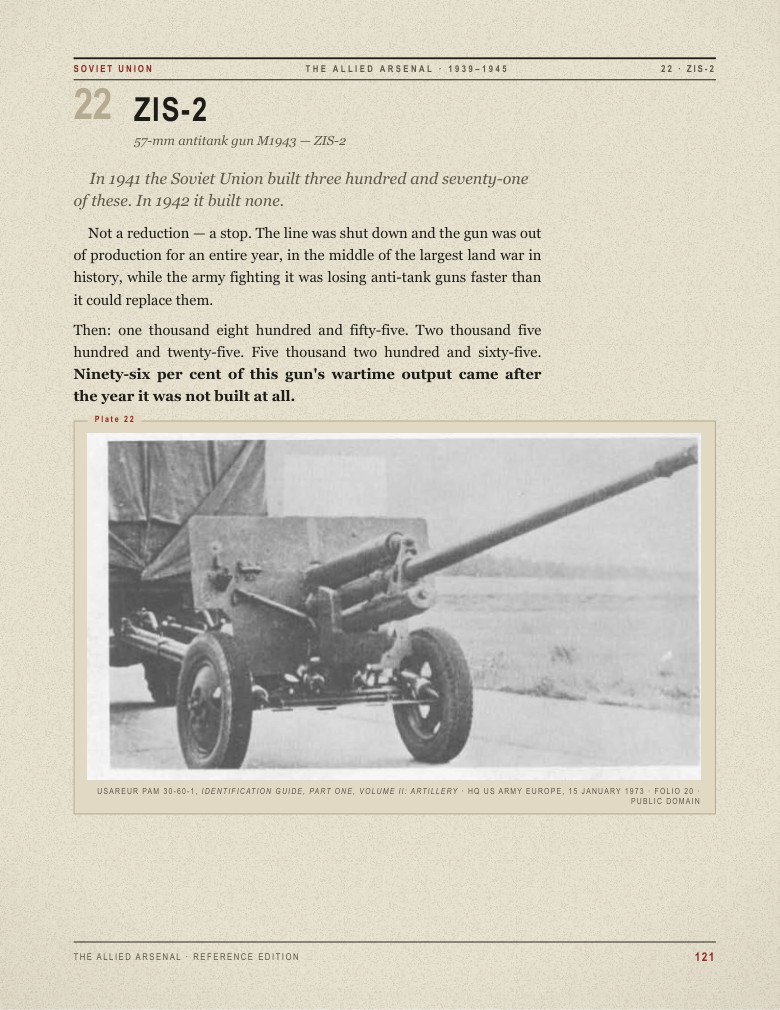 Page 121
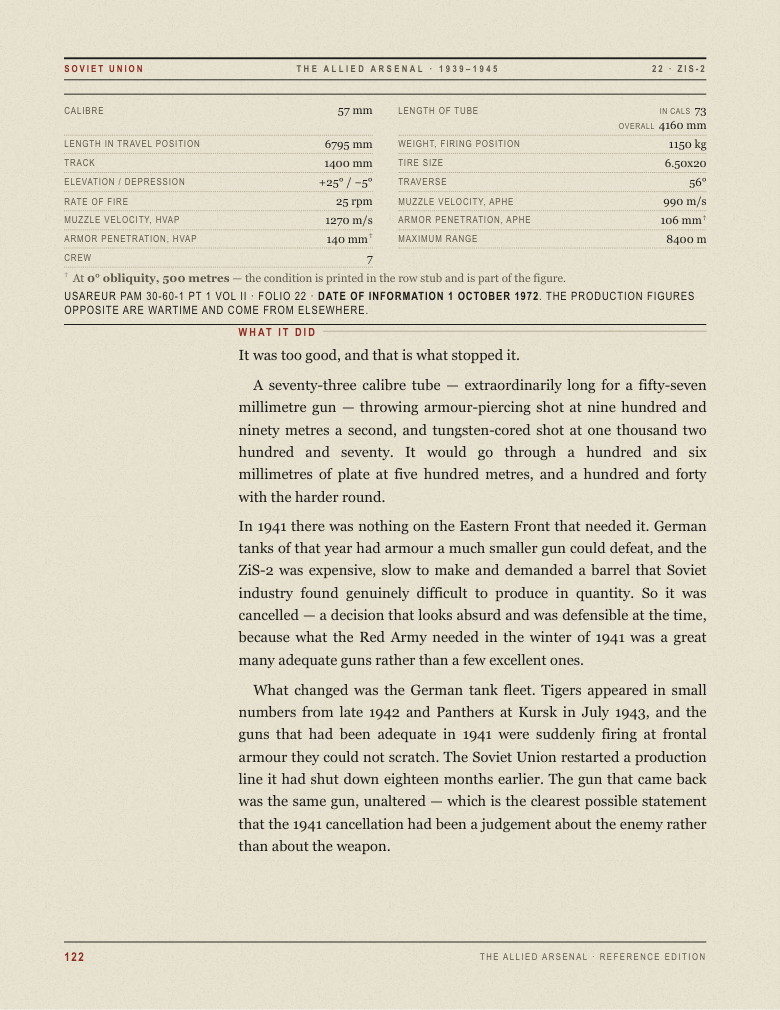 Page 122
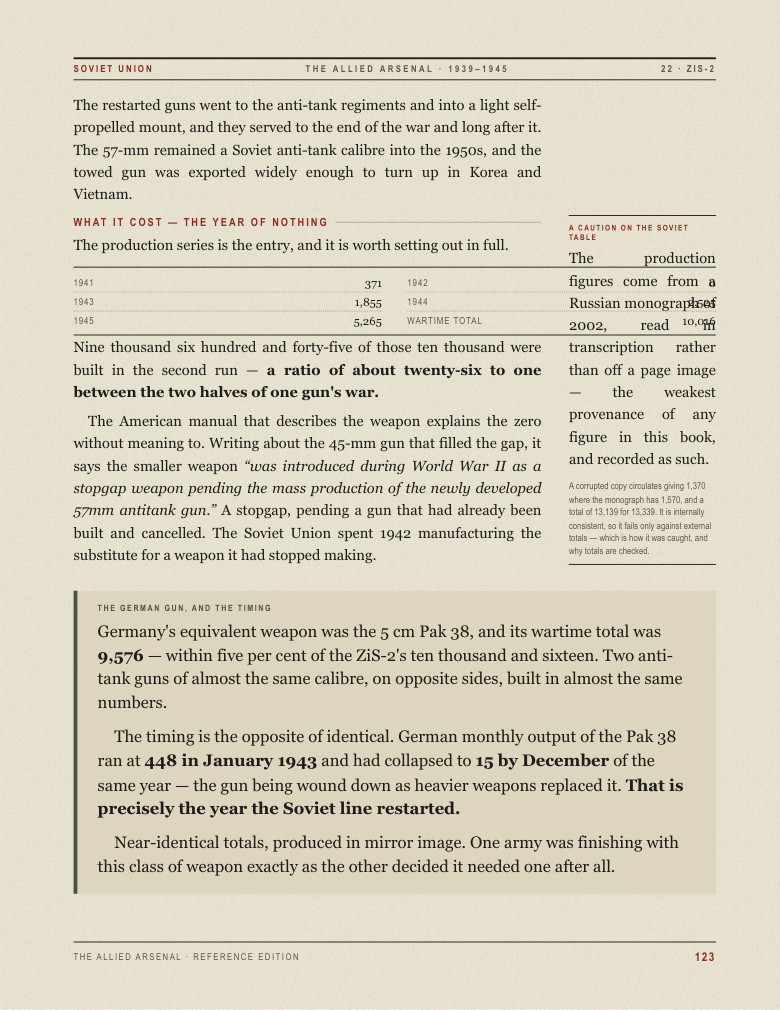 Page 123
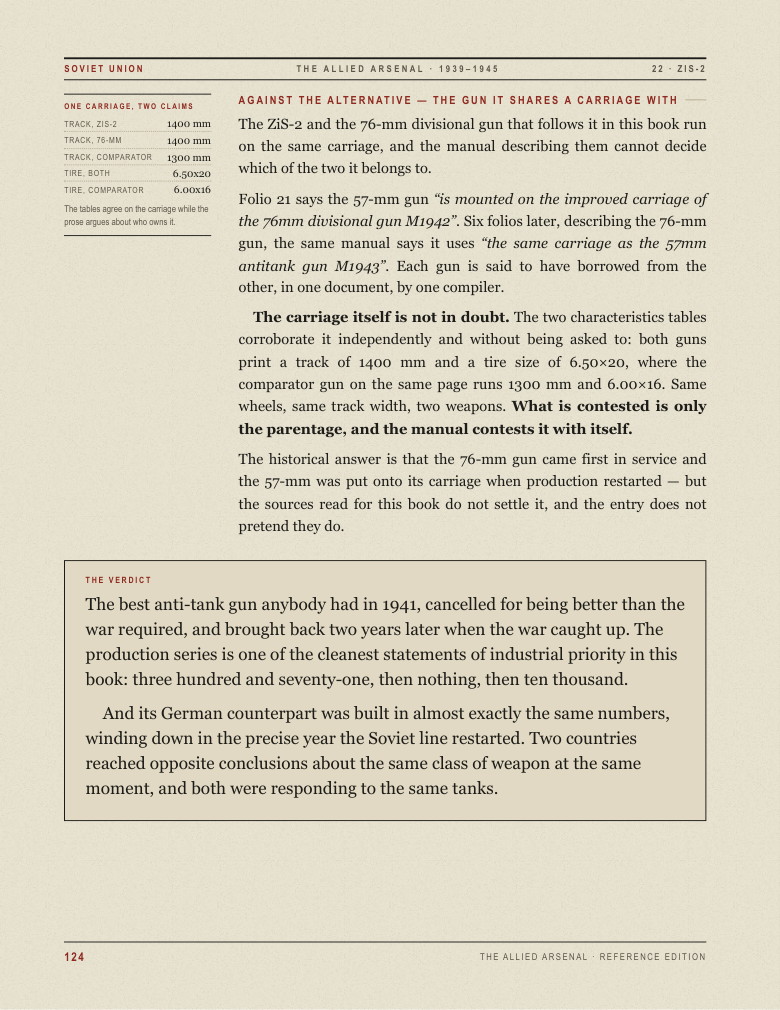 Page 124
Would rather start with the free Field Reference? It's here →
Method
How each entry is built
- Collect the period manuals and technical publications
- Pull production and procurement records for the same weapon
- Reconcile the figures — and note where they disagree
- Write
- Technical review
- Layout, and drawing to common scale
- Final source check, entry by entry
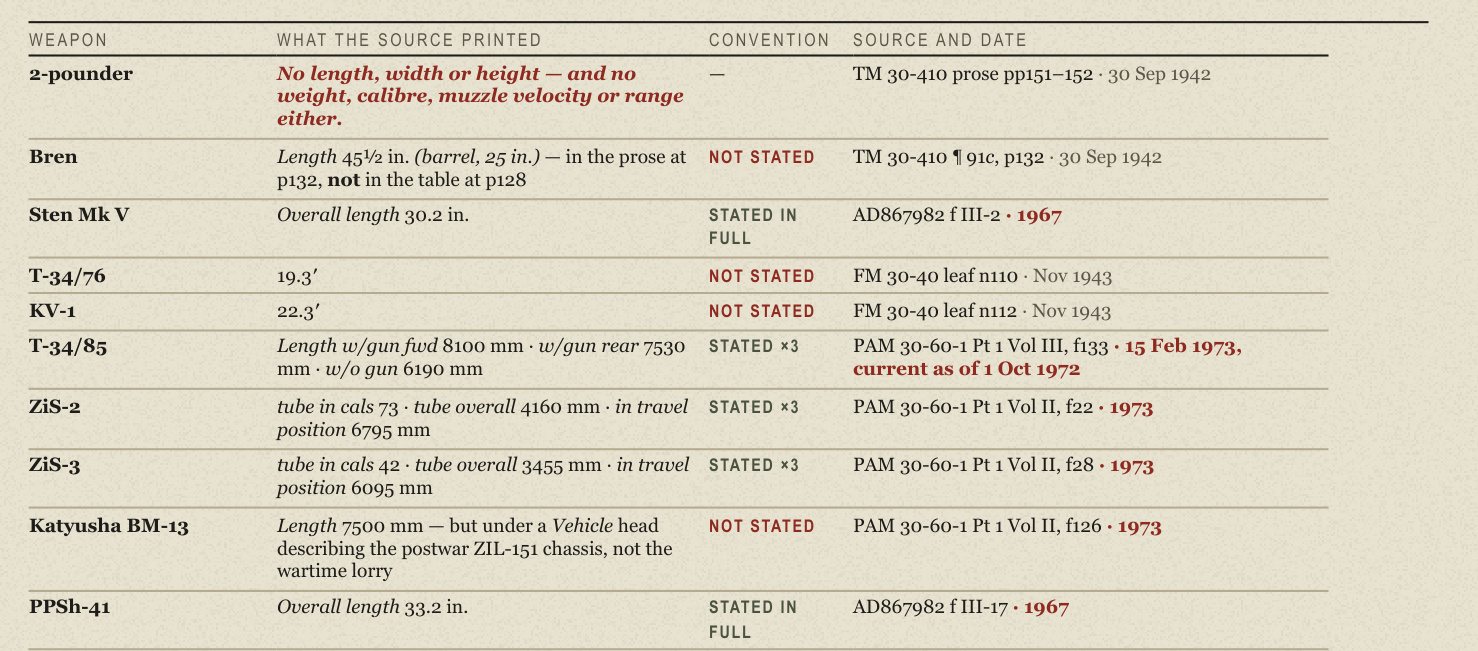
Step three is the one that takes longest, and it is the reason these references exist. Published figures for the same weapon frequently conflict. Most books pick one. This one shows you both, and tells you which record it came from.
Attribution
How a figure is attributed
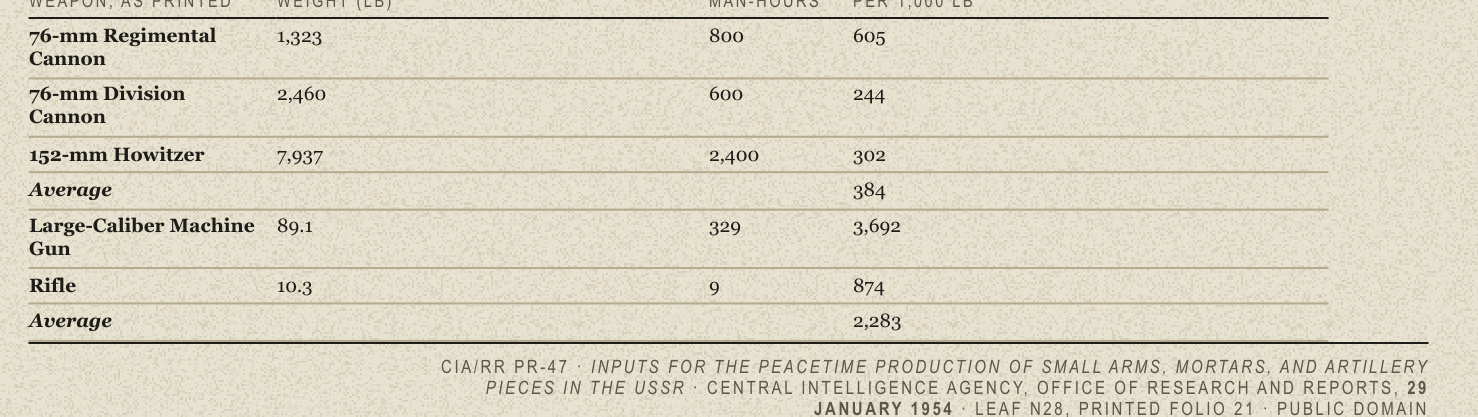
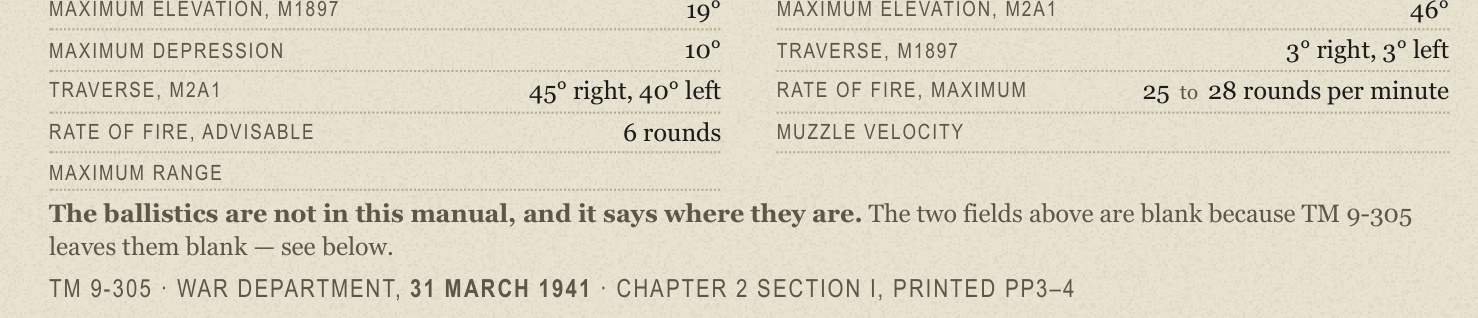
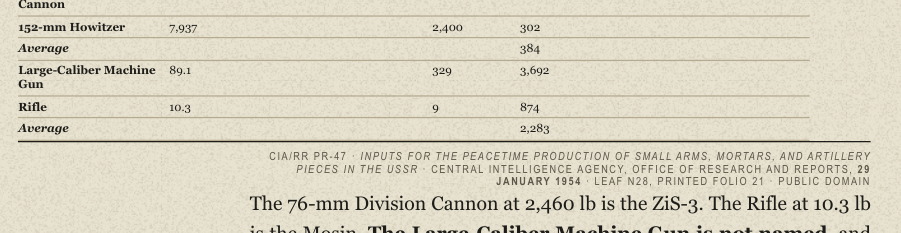
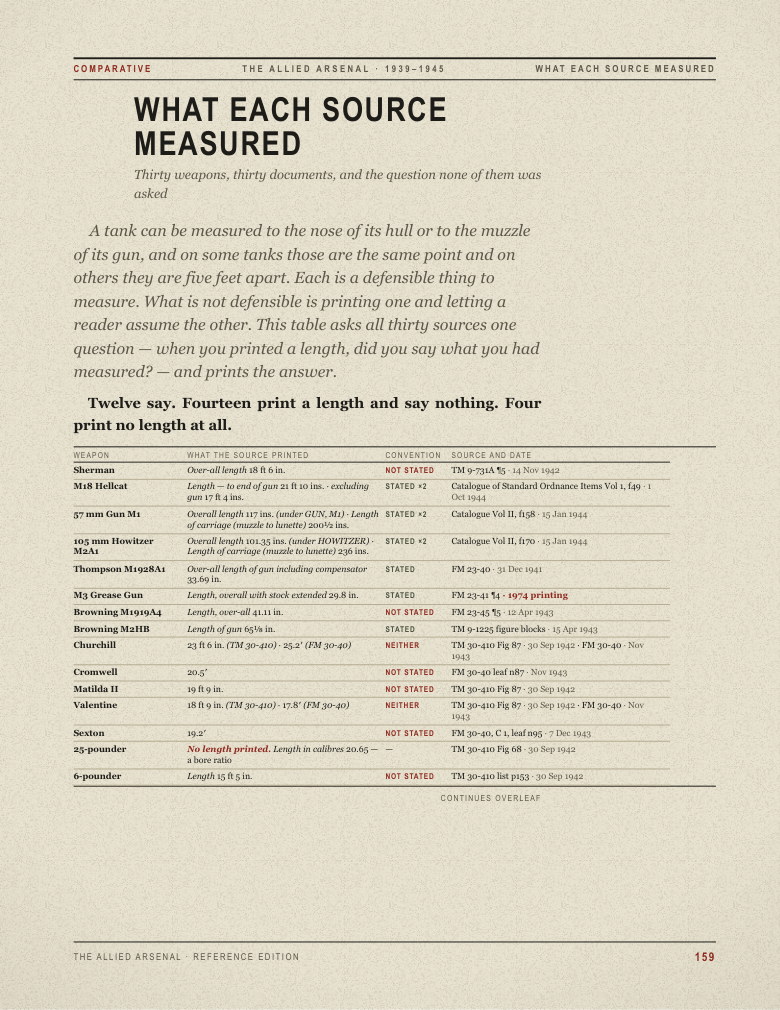
Every number in these references carries the document it came from. Not a bibliography at the back — the document, the date and the leaf, printed under the table the figure sits in. Four pages from the Arsenal Reference, unretouched.

Interior
Inside the Arsenal Reference
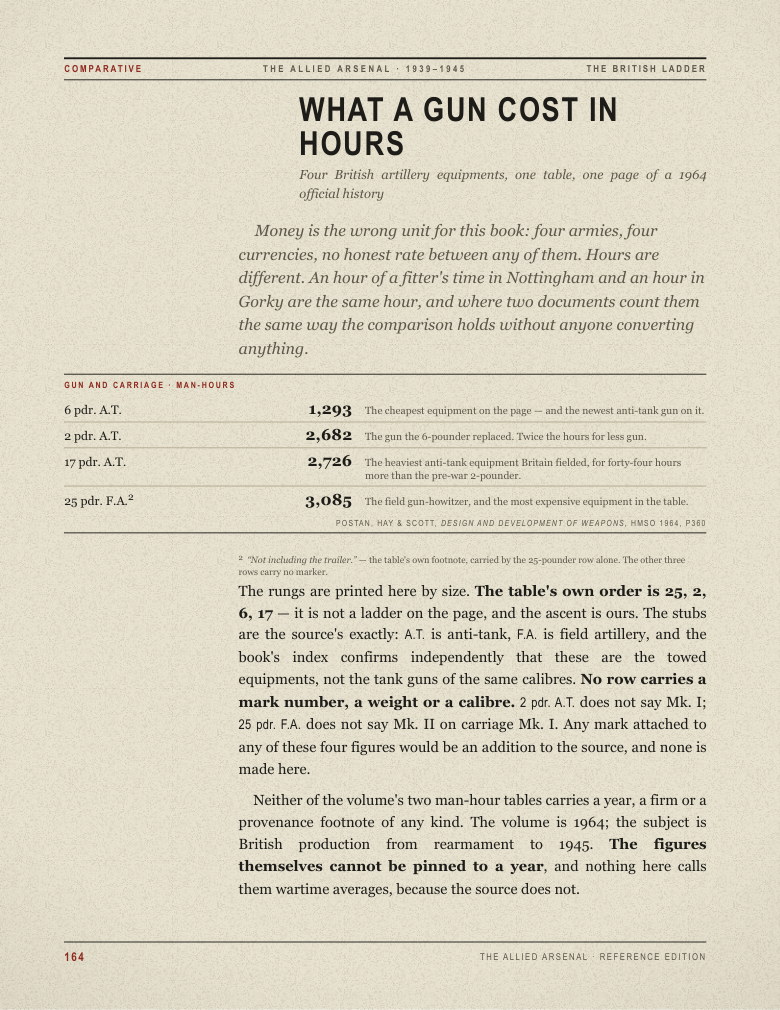
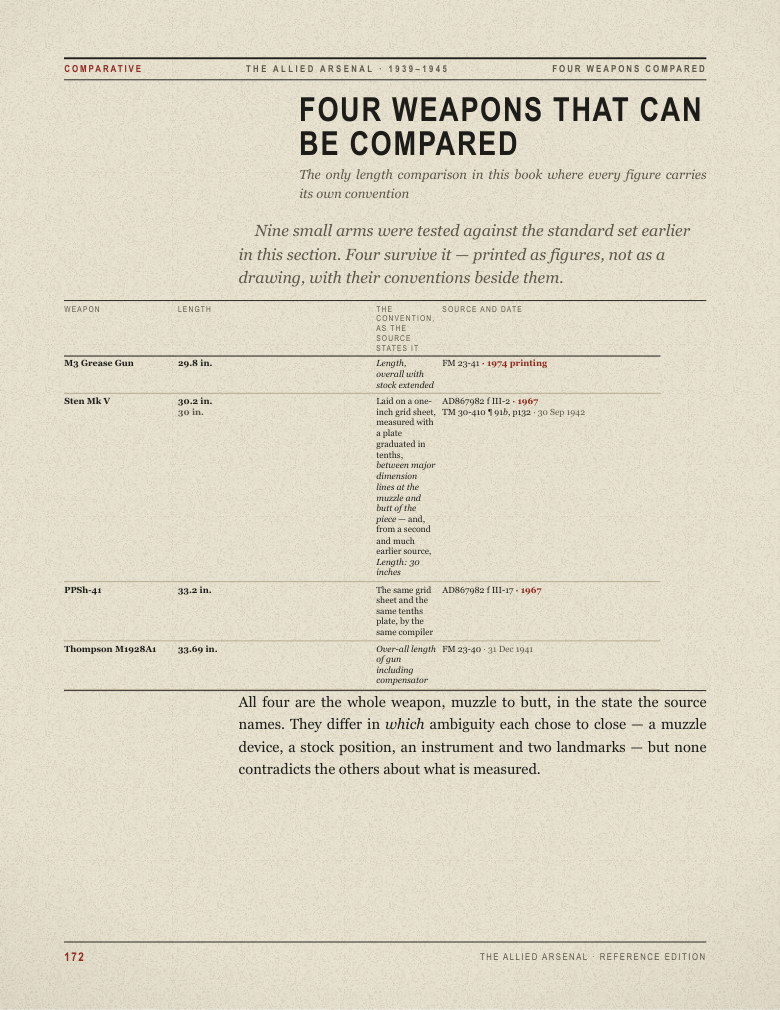
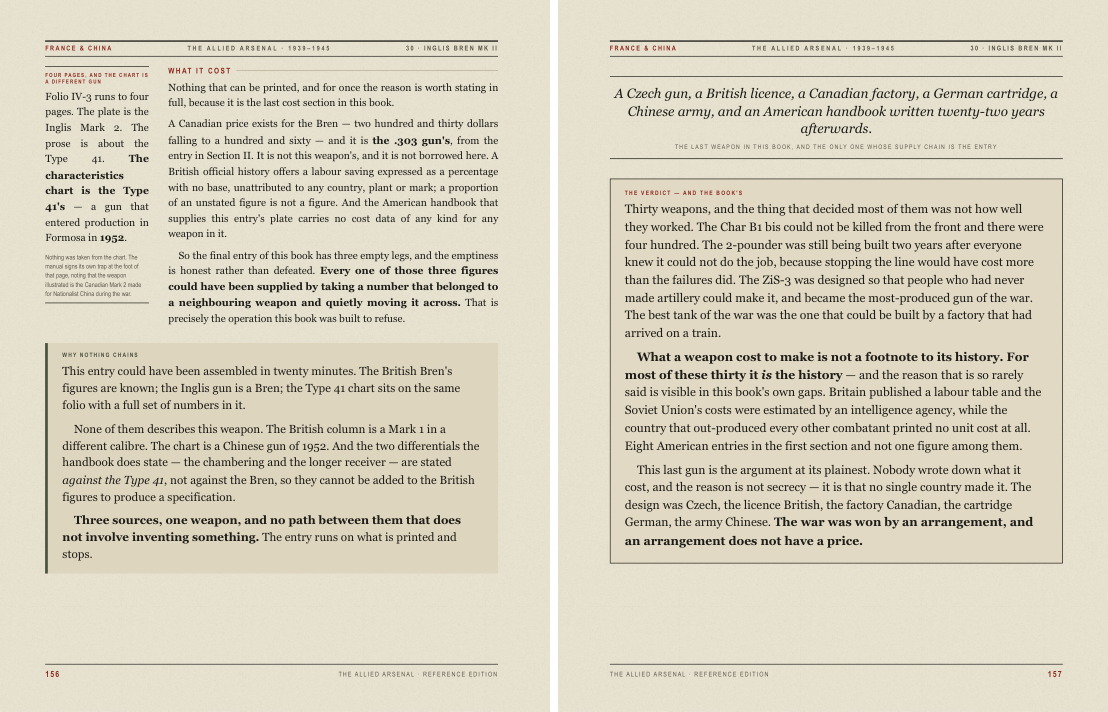
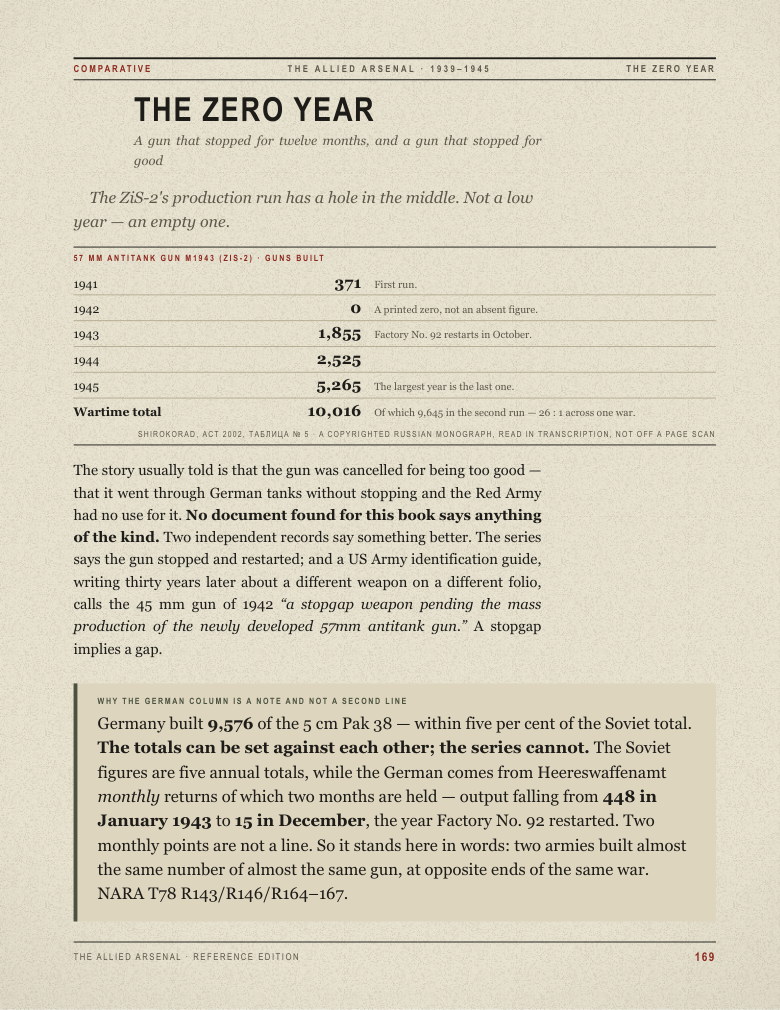
The reference
What the Arsenal Reference covers
Thirty Allied weapons — armour, anti-tank, artillery, submachine guns and machine guns. Contract prices where a contract survives, man-hours where a ministry counted them, factory output by year, and the procurement decisions behind all three. Every figure attributed the way the four above are.
See the Arsenal ReferenceStandards
Editorial standards
- Every figure in these references is traceable to a document, and the document is named.
- Where two records disagree, both are given, and the disagreement is stated rather than resolved silently.
- Where a figure is reported rather than confirmed, it is marked as reported.
- Where a comparison could not be made honestly, it was not made — and the reason is printed in the book.
Detail
Questions
Why isn't this on Amazon?
Two reasons. Amazon's formats don't handle the tables and technical drawings this book is largely made of — the layout breaks. And once a book is in the catalogue, existing buyers can't be sent a revised edition. Selling direct means the material stays as it was compiled, and everyone who owns it gets every future revision free.
What sources were used?
Every plate in the book is a figure from a named government manual, credited individually to its manual, with the figure number and date where the source prints them. The American entries come from War Department technical manuals — TM 9-1275 for the Garand, TM 9-1270 for the Springfields, TM 9-1276 for the carbine. The British entries come from TM 30-410, the War Department's 1942 Handbook on the British Army, and the P14 from FM 23-6. The Soviet plates are postwar US intelligence publications — FSTC-CS-07-35-66 and the Special Forces Foreign Weapons Handbook — because no wartime Allied manual in the public domain illustrates those weapons, and the book says so where it happens. Every photograph is a wartime original taken between 1939 and 1945, most from the Library of Congress and the Office of War Information. Five entries carry no plate at all, and each of those explains why rather than substituting something else.
Can I print it?
Yes. A print-optimised version is included with every purchase, laid out for a standard home printer.
Will updates cost extra?
No, permanently. When a new edition is issued you will be emailed a link to it at no charge. This applies to every buyer, including the first one.
Do I need an account?
No. You pay, you get a download link by email, and that is the end of it. There is nothing to log in to and nothing to cancel.
Will you sell or share my email address?
No. I use it to send you the book and occasional research notes. There is an unsubscribe link on every email and it works immediately.
I already have a large WWII library. What is actually new here?
The production and procurement side. If your shelf already covers what these weapons did, this covers what they cost, how long they took, who built them, and why they were chosen over the alternative. If you find it duplicates what you already own, the terms for returning it are on the sales page.
Request
Start with the free Field Reference
Twenty rifles, complete, at no cost. If you decide the paid reference is worth your time after that, it will still be here.
Or go straight to The Arsenal Reference →